All The World’s an Orifice

Standard

Alternate title: What the hell is Nicholson Baker trying to say in House of Holes?

“Look up at those great clouds while […] I fuck the planet earth.”

House of Holes Cover Published in 2011, House of Holes is described on the back as “a modern-day Hieronymus Boschian bacchanal set in a pleasure resort where rules don’t apply.”

I don’t know what some of those words mean. I’d describe it as a filthy, fun, sci-fi porno enriched by Baker’s wonderful gift for language, but fails to hold my undivided interest for the entire thing. In that sense, it’s almost exactly like a porno. I’ll go back to it occasionally, but not to re-read the whole thing. I’ll just flip to the money shots.

Like these: “You mean I’m supposed to wank while Crackers does a lap dance?” (97) Even in context, I find this line LOLable.

Or this dry exchange: “Thank you,” said Kazumi. “I will let you feel my breasts now.” “Okay, great. Thanks.” Wade felt her breasts. (117)

Anything that isn’t completely out there and/or repugnant (like a woman being shrunk to a half-inch in size and stuck in a man’s penis, forcing him to masturbate her out.) is given nary any page space. “Mindy cooked him a three egg omelet and he ate it.” (228) And then back to the bangin’!

Holes is a collection of loosely related stories with recurring characters. Each one has a setup usually involving two strangers who have absolutely no qualms about discussing their most private and kinky sexual fantasies with each other. Then they do them. And anything is possible in the strange sci-fi world of the House of Holes, especially when it starts off with a girl named Shandee finding a disembodied arm that then feels up her roommate (causing Shandee to get fo’ realz jealous), that then transports them to a magical sex carnival.

Nicholson Baker

This man has the filthiest imagination ever. Image from the Post-Gazette. Click for an interesting article titled "Is House of Holes necessary?"

The set-up, brief exposition, XXX action, and money shot would get tiring if it wasn’t so incredibly out there and imaginative.

Still, after almost 200 pages of this, I started to wonder: Why?

It’s not until page 167 until any of his characters seem to show any form of human emotion, but in a very robotic fashion.

“And what after all is a soul mate?” “A soul mate is when you really think someone is great. You really like her a lot. You like when she explains things to you. You love her. That’s a soul mate.” “Oh,” said Trix. “Will you take me to the groanrooms?” Then they go to a pitch-black room and moan at each other. It’s like an aural orgy.

Later, there’s a very interesting chapter about Ned, who has his head detached (don’t worry, he’s fine), which leaves his body to have sex all by itself and the woman named Reece who rents out his body in the Headless Bedroom. She kind of has to teach the body what to do, sexwise, and grapple with her own feelings about casual sex. What’s more casual than having sex with a body that can’t think, speak, or respond?

If the tables were turned, and the woman was headless, it would come across as quite sexist at the least. But Baker never makes his women objects. They have their own desires and drives, and they always get what they want too. Even though all the sex is exclusively hetero, it’s a very inclusive book, spanning many different fetishes.

Holes has a surprisingly wholesome message: Two consenting adults can and should be able to do whatever the heck they want without any judgment. Your imagination is the only thing holding you back.

Baker occasionally makes other points beyond just “ngghghghghgh.” When magically removing a client’s tattoos Hax says, “[Tattoos are] something that hides you. It is a way of not being naked while being naked” (110). And when magically growing back Jessica’s pubic hair, Hax says about shaving, “That, too, is a way of hiding. No hair means you are dressed in hairlessness. You are finding a way to be clothed when you aren’t clothed. Hair is your true nakedness. Do you want your nakedness back?” (110) I hate living in such a shaved and plucked society. Hair is a statement. Hairlessness is the cowardly way out, and Baker put into words something I didn’t even know I had been thinking for a long, long time.

The book has what seems to be an almost backwards ending. A small couple made out of silver living in an egg (ignore the silver skin and egg part if you must) discover their own private parts, that they give them pleasure, and that they’re attracted to one another. On the last day the House of Holes is open for business, the egg hatches and the couple copulates in front of a cheering crowd of hundred.

Yes, this kinky book ends with a couple in love having vanilla sex with one other. Of course it’s voyeuristic, but every book taps into that voyeuristic desire to see and analyze someone’s private life. Back to the point, this couple is cheered and celebrated in its innocence.

So what do we learn, along with the residents of the House of Holes? Despite your kinkiest desires (and may they bring you the greatest of pleasure when you act them out safely and responsibility), loving sex of any kind, no matter how plain, is to be celebrated and revered.

I also recently finished Baker’s The Mezzanine, which, as far as Holes go, is startlingly clean. But it has the same wide-eyed appreciation for seemingly mundane aspects of life that I really connect with. I’ll write about that book soon.

Book Club Recap: The Tower, the Zoo, and the Tortoise

Standard

It was unanimous. Our book club loved Julia Stuart’s The Tower, the Zoo, and the Tortoise. After a few too many heavy, depressing, ponderous reads in a row (The Thirteenth Tale, Fifth Business, not that there’s anything wrong with those!) this charming novel was exactly what we needed. It’s a really good book to read around Valentine’s Day, too, with its over-arching themes of love, loneliness, and loss. Ah, the three Ls. And I love reading books with a British accent. Plus, cute animals!

The Geoffroy's Marmoset is from Brazil. (Image from Brandywine Zoo)

Why yes, they can walk on water. These basilisks are also known as Jesus Christ lizards. (Image from Strange Animals)

Balthazar Jones steals one of these bearded pigs from the Zoo. It plays with a grapefruit as though it's a ball. So adorable! (Image from London Zoo, maybe this was the one he took!)

Balthazar Jones bonds with the wandering albatross in the book. Both are longing for their mates, whom they have been separated from. (Image from BBC)

A group favorite was Mrs. Cook, Balthazar Jones’s 180-something-year-old tortoise. “Generations of Joneses had completely forgotten [she] was a tortoise. She was regarded more as a loose-bowelled geriatric relative with a propensity for absconding, such a protracted habit that nobody ever realised she had vanished until weeks later, as her sedate trajectory across the room was still burnt on their memories.” (49)

Anyway, the book was an utter delight. We had so much fun and laughter at book club, just sharing passages and guffawing. Sure, I was operating on about four hours’ sleep, but I still would have had a few good belly laughs were I well-rested.

Despite all the humor, the book is definitely deeper than the cover would lead you to believe. All the characters, even the animals, experience a variety of profound feelings of longing, loss of a loved one, or sorrowful loneliness.

Plus, Julia Stuart’s way with words is just phenomenal. She constructs rich, vivid, and many times hilarious scenes without excessive wordage or description. Even her repetition–always using a character’s first and last name, always referring to certain object the exact same way–served to just enrich a scene for me, and not annoy me.

The Tower of London backdrop, and all the really bizarre historical facts that get recounted throughout the book (Sir Thomas Overbury executed by mercury enema; Mary Toft, the woman who gave birth to rabbits), serve to make the sheer quirkiness of the characters seem almost normal. Oh, Valerie Jennings is stuck inside a horse costume and trying to open the fridge with her hoof? Just another normal day in the London Underground Lost Property Office.

My favorite character was Rev. Septimus Drew, who writes erotic in his spare time under the nom de plume Vivienne Ventress. He uses all the royalties to support a home for retired prostitutes, where the gentle ex-hookers grow luscious carrots that they sell to local restaurants.

Anyway, this book is such an enjoyable treat, I really would recommend it to everyone. Quirky without being cute, emotional without being manipulative, and with so many odd history facts that you’ll definitely want to share with friends make it a must-read, and I rarely say that.

I can count on one hand the number of books out book club unanimously enjoyed in the last two-three years: The Help, Stephen King’s The Stand (believe it or not), all but one of us loved The Thirteenth Tale. So this book is definitely an achievement to appeal to all our finicky tastes.

There are few books I would recommend to anyone and everyone, but if your reading tastes range beyond military fiction and serial killer true crime, you would probably love this book.

The Perks of Re-Reading a Book

Standard

The Perks of Being a Wallflower movie, with Emma Watson, recently got smacked with an R rating, which is being appealed.

Man, did I love this book when I was in high school. I bought it when it first came out, and still have that copy today. Actually, I think I have a different copy because some bitch borrowed it and kept it, but that’s not the point.

I recently re-read it and was surprised by 1. how much I remembered after 10 years and 2. how much I completely forgot.

Now I see why this book is so popular. It has pretty much every single YA trope in it: drugs, first kiss, sexual abuse, dealing with sexuality, teen pregnancy, abortion, distant parents, making friends, bullying, suicide, and melting your hand with molten silver. Okay, that last one might be from Johnny Tremain, but all the rest is in there.

I think the reason I forgot so much of it, was that, when I first read the book at sixteen, I just chose the parts I identified with and pretty much discarded the rest. Kind of like picking the marshmallows out of a bowl of Lucky Charms and tossing the cereal. Because I wasn’t into drugs as a teenager, I didn’t remember that they were high half the time in the book.

That whole pick-and-choose method isn’t part of my reading strategy anymore. I don’t know when that changed. As a result, I didn’t care for the book as much upon re-reading it. And I found the narrator extremely tiring. Tiring to the extent of reading A Curious Incident of the Dog in the Night-Time. But that kid had autism, so he had an excuse for his repetitiveness and emotional outbursts. As far as I know, “Charlie” in Perks has no excuse, so he was annoying in addition to tiring.

Plus, the whole thing came across as a little false, like an adult writing letters pretending to be a teenager (which is exactly what the book really is.) Charlie talks about how he needs to learn grammar, punctuation, and spelling, but it’s pretty much flawless. That may seem like a nitpick, but it’s hard to think you’re reading letters from a teenager when they’re written in perfect English. Most adults don’t write that well.

Despite Emma Watson being in the movie, I doubt I’ll see it in theaters. Maybe when it hits the Redbox.

The Tower, The Zoo, and the Tortoise

Standard

I recently finished Julia Stuart’s The Tower, The Zoo, and the Tortoise for my book club. It was nice to have a whimsical read for once, although this book isn’t as light-hearted as the cover might lead you to believe. There’s a heavy element of loneliness and loss running through the entire book made all the more sharp when it appears by the sheer silliness that occurs at regular intervals. I have to say, Julia Stuart’s brand of comedy really worked for me. She conjures up some hilarious images–like Valerie Jennings stuck in a horse costume–that wouldn’t be out of place in classic slapstick British comedy. This is a rare book that had me laughing out loud, and even rarer one that almost brought a tear to my eye. It was probably just  dust, I swear.

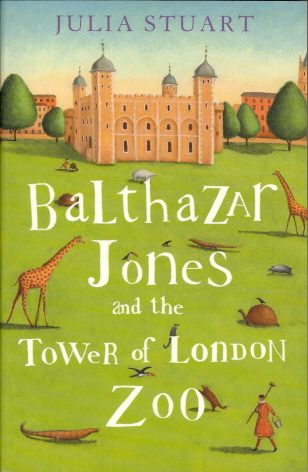
Doing research for book club, I learned that the book was originally called Balthazar Jones and the Tower of London Zoo. Not a good title, but the cover was nice. While his relationship is the focus of the novel, and gets the most page space, there are at  least a dozen other characters with their own storylines. Although I must admit that I was totally in love with Balthazar and his beautiful eyes.

I liked the Reverend Septimus Drew the most. He writes erotic fiction. Not only that, but he’s been shortlisted for a Best Erotica award. I should have been paying more attention to The Vicar of Dibley, because I wasn’t sure what type of priest was allowed to date and eventually get married like Septimus Drew has hopes of doing.

He has his eyes on Ruby Dore, the barmaid, whom I liked, even if she is a bit hypocritical. When she discovers the Reverend’s writing, she gets angry with him, saying a man of God shouldn’t write things like that, etc. etc. Meanwhile, she’s pregnant with a one-night-stand’s baby. I thought it was a little odd that she would get mad at the one nice man in her life for simply doing what he likes to do. A little erotica never hurt anyone.

Anyway, I’ll write more about the book after book club. I want to say that I also enjoyed all the historical references, which must be true because they’re too crazy to ever be made up. The fact that history is so ridiculous (one Tower prisoner was executed with a mercury enema) makes the quirky fictional characters in the book all the more real. Also, it’s filled with some of the cutest animals ever. The Etruscan Shrew is my new favorite mammal.

Smallest Mammal in the World! picture from thefeaturedcreature.com

Snapshot Storytelling

Standard

I’m almost done with Super Mario 3D Land, and will have my complete thoughts on it up soon. (Spoiler alert: I like it!)

The game is a little 3D love letter to Super Mario Bros. 3. Nintendo’s been milking SMB3 nostalgia for a while now, with New super Mario Bros. and New Super Mario Bros. Wii, but it doesn’t feel stale yet. Perhaps because the mechanics behind SMB3 were so solid.

Something I really appreciate about SM3DL is the unobtrusive way it tells its story. Raise your hand if you’re playing a Mario game for the story. *waits* Right, didn’t think so.
I don’t think there’s any text whatsoever. The opening cinema sets up the plot–something about a tree covered in Raccoon leaves, which transforms Bowser and all his cronies into Raccoon-tail-wielding hybrids. Oh, and Peach is kidnapped too, natch. Then, in between each world, Mario catches a little flying envelope from Princess Peach, showing what’s going on at Bowser’s castle.

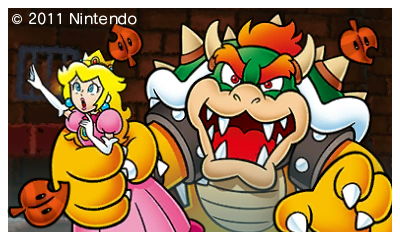
Inside each envelope is a photograph. The illustrations are nice, and harken back to older Mario art, except with the updated character designs. Thankfully, we never have to see Peach look like this again:

The 3D effects make the photos pop. But they also show something interesting: Princess Peach isn’t content to be a damsel in distress this time. She sulks around Bowser’s Castle for a bit, but around World 4, she plots her escape. She even manages to clobber a tower of Goombas with her parasol. And all of this without crying or tapping into her magical PMS powers. This is a Mario game, so of course she gets recaptured and put in a cage, but at least it’s a stylish one.

I probably wouldn’t have noticed or cared if I hadn’t recently suffered through Skyward Sword. The bland storytelling of that game was made almost insufferable by the copious amounts of repetitive text you have to scroll through. A lot of times I’m playing a game to, well, play a game. I read a lot of fiction, and many video game stories aren’t that great to begin with. It’s even worse when they’re not well incorporated into gameplay.

My favorite video game story of all time is Grim Fandango. What’s yours?